Why Memorizing Won’t Make You Smarter (And Get Better Grades)
Do this instead


When I was a student, I used to study like this:
I’d take the material to study and highlight it.
Then, I’d transcribe the highlights into a summary.
I’d read and study the summary.
Although this is not wrong, it is ineffective.
Why? Because you don’t remember better by trying to remember harder. I know, this is counterintuitive. But more effort into rereading, highlighting, and note-taking doesn’t necessarily mean that the information will stick in your long-term memory.
I lost count of how many times I tried to memorize my notes before a big exam, only to forget most of what I studied hours before it.
Did this happen to you? Well, this is the illusion of learning.


☕️❤️ Support my work to continue writing by buying me a coffee.
How To Actually Remember What You Study
Let’s start understanding the psychology of memory.
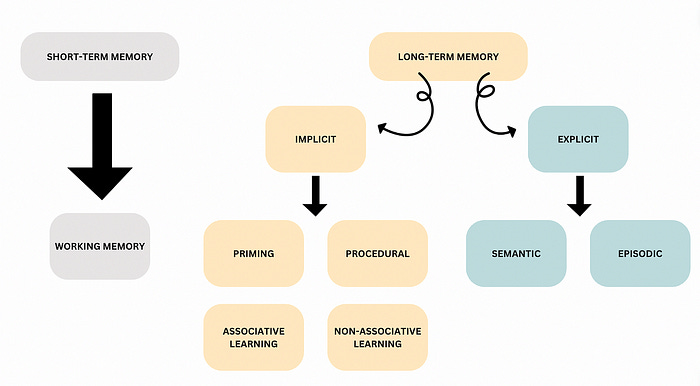
Memory can be divided into:
Short-term memory: lasts seconds or minutes.
Long-term memory: lasts hours, days, months, years, or a lifetime.
Learning is about linking information to your long-term memory.
When you reread and highlight (or both), you store the information in your short-term memory. This gives you a false sense of understanding, called the illusion of learning, by making you fluent in what you read. This also happens when you learn something by re-watching course videos.
This is the reason why you forget most of what you studied hours before your exam. Because the information you read was only organized into your short-term memory (and because of that, it created a false sense of knowledge, the illusion of learning).
So, how can you link data to your long-term memory to learn something effectively?
Well, by finding study strategies that help you bring information to your mind often and effortlessly. You may have heard that we learn something faster when we are doing it. And it is right. This works because you’re constantly retrieving information you learned. With time, this recall helps link information to your long-term memory.
The gold standard technique for this is retrieval.
You (can) practice retrieval in many situations:
When you test yourself.
When you do elaborative interrogation (ask and answer how- and why-questions).
When you close your book and do free recall.
When you study using flashcards.
The more effort you put into retrieving information, the better you learn.
2 Easy Ways To Start Practicing Retrieval Now
Strategy 1: Free-recall
Close your book.
Recall what you learned so far (without looking at your book).
Get feedback on the correct answer.
See what you know and don’t know.
Repeat.
Strategy 2: flashcards
Create flashcards from your material.
Answer the questions honestly, without looking at the correct answers.
Test yourself and get feedback.
See what you know and don’t know.
Repeat.
Summary
The illusion of learning arises when you think you learned something when you didn’t.
This mainly happens through ineffective study strategies such as rereading, highlighting, and rewatching. The core of the problem? The idea that memorizing or trying to remember harder correlates with learning and better grades.
A better technique involves retrieval, a strategy that consists in bringing information from your short-term memory. The more you recall, for example, by free recalling or testing yourself with flashcards, the easier it is for your brain to store that information in your long-term memory.
Hopefully, this helps you in your following exams!
Ultra-learning saved my career.
It helped me learn anything without overstudying or overworking. But remember, each person has a different life. Perhaps you work full-time and also study. Or maybe you have a family, etc.
Be reasonable, and don’t fall into toxic productivity.
Here are some last recommendations:
Don’t compare yourself with others. Take your time.
This is not a competition. This is about you. Make it fun and healthy.
Please take care of yourself. That’s the most important thing!
Now it is your turn.
What are you going to learn next?
☕️❤️ Support my work to continue writing by buying me a coffee.